If you have lost the motivation to work out, the first thing worth knowing is that motivation is rarely what went missing. Something else broke first — the progress you could see, the plan that fit your week, the streak you were protecting — and the wanting faded after it. That is good news, because those things can be fixed on a Tuesday, without waiting to feel like it.
This guide covers why training motivation fades, what the research says actually brings people back, a two-week restart you can start this week, and — since we make one — how the PlayThenics app is built for exactly the week you come back.
Why motivation to train fades
Four causes cover most of it. Read them and one will probably sound familiar.
- Progress stopped being visible. In the first months everything moves: reps climb every week, holds get longer. Then gains slow to a rep a month, and without a record you cannot tell slow progress from none. Most people who quit calisthenics do not quit because it got hard. They quit because nothing they could see was moving.
- The plan was built for your best week. Five sessions of an hour each works until work, illness or a move eats a week. Then the plan is either all or nothing, and you pick nothing.
- The streak broke. A daily streak feels great at day 40 and terrible at day 41. Once it is gone, the reason to show up today goes with it — and a streak that punishes rest days teaches you to train hurt before it breaks.
- The rewards were not about training. Points for opening an app, badges for logging anything. They feel good for a week and then mean nothing, and research suggests they can make the activity itself feel less like yours. More on that in how gamified fitness apps go wrong.
What the research says brings people back
Five findings from behaviour research are worth more than any motivational video:
Swipe sideways for the full table →
| Finding | What it means for your training |
|---|---|
| Monitoring progress helps people reach goals, more so when it is written down [1] | Log your sets. Not for the data — because seeing a number move is the most reliable source of wanting to train again. |
| Habits take a median of 66 days to become automatic, and missing one day does not measurably set them back [2] | Expect two months, not three weeks. A missed session is not a failure of the habit; quitting after it is. |
| "If–then" plans — when X happens, I will do Y — had a medium-to-large effect on follow-through across 94 studies [3] | "I will train more" does nothing. "Monday after work, before dinner, I do 20 minutes" does. |
| People start new behaviours more often after a fresh start: a new week, a new month [4] | Use Mondays and the 1st on purpose. They are not a cliché; they work. |
| Expected, tangible rewards tend to undermine the enjoyment of an activity people already liked [5] | Reward yourself with evidence — a record, a rank, a harder step — not with points. |
A two-week restart
This is the plan for someone who has not trained in two weeks or two months and wants to stop thinking about it and start.
Days 1–3: make the first session tiny
- Pick one time this week, and write it as an if–then: "Wednesday, 7 pm, when I get home, I train for 20 minutes."
- Do about two thirds of the working sets you used to do, at an easier variation if you are unsure. The goal of session one is to end it wanting a little more.
- Log it. One session is the whole win.
Days 4–7: let one session count the week
Your target for week one is not "back to normal". It is one session this week, and two if the first one felt easy. A week with one session is a training week. A week with zero is the only kind that breaks anything.
Week 2: start on Monday, and look for something true
- Plan two or three short sessions, each tied to a time and a place.
- Before the first one, look at your old records. Most of them still stand: strength is generally well kept over short breaks of up to about four weeks, and it returns faster than it was built [6].
- Try to beat one small thing — a hold by two seconds, a set by one rep. Not your all-time best; your best since coming back.
How PlayThenics is built for the week you come back
We make PlayThenics, a calisthenics tracker for Android, and most of what is above is built into it. Not as a pep talk — as the way the app counts.
- "Your records stand." Open the app after two weeks or more away and it starts with what you kept: your rank, your records, the progression steps you own, and your run of training weeks — "It continues from there." Then one button: start a comeback session.
- Training weeks, not daily streaks. One session counts the week. A rest day cannot break it, and a short week still counts. That is the 66-day finding turned into a rule: a missed day is not the end of anything.
- Rank does not drop while you are away. Your rank in each of six movement patterns is measured from the sets you logged against published standards. It never goes down for absence; after long enough without fresh evidence it asks for a retest instead.
- Reminders that stop. After a break the app may send a few reminders from the phone itself, timed to fresh starts — like the Monday after a quiet week — and naming a record of yours rather than scolding. Then it stops. They have their own switch, so you can mute them without muting anything else.
- A look back every Monday. When a new week starts, Home shows last week: training days, new records, rank moves. Visible progress, without you having to go looking for it.
- No points, no XP. Nothing is awarded for opening the app. Every record and rank is tied to a set you did — so it keeps meaning something. And if any motivation feature is not for you, each one has its own switch; the app stays a full tracker with all of them off.
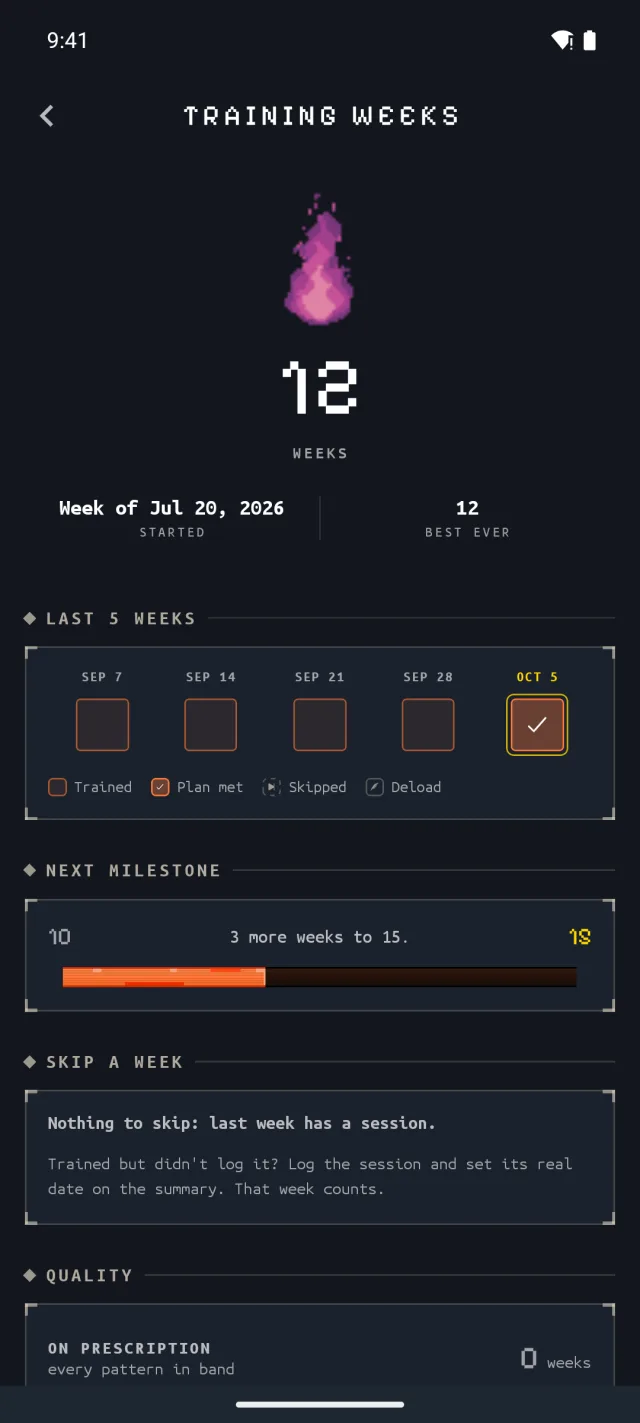
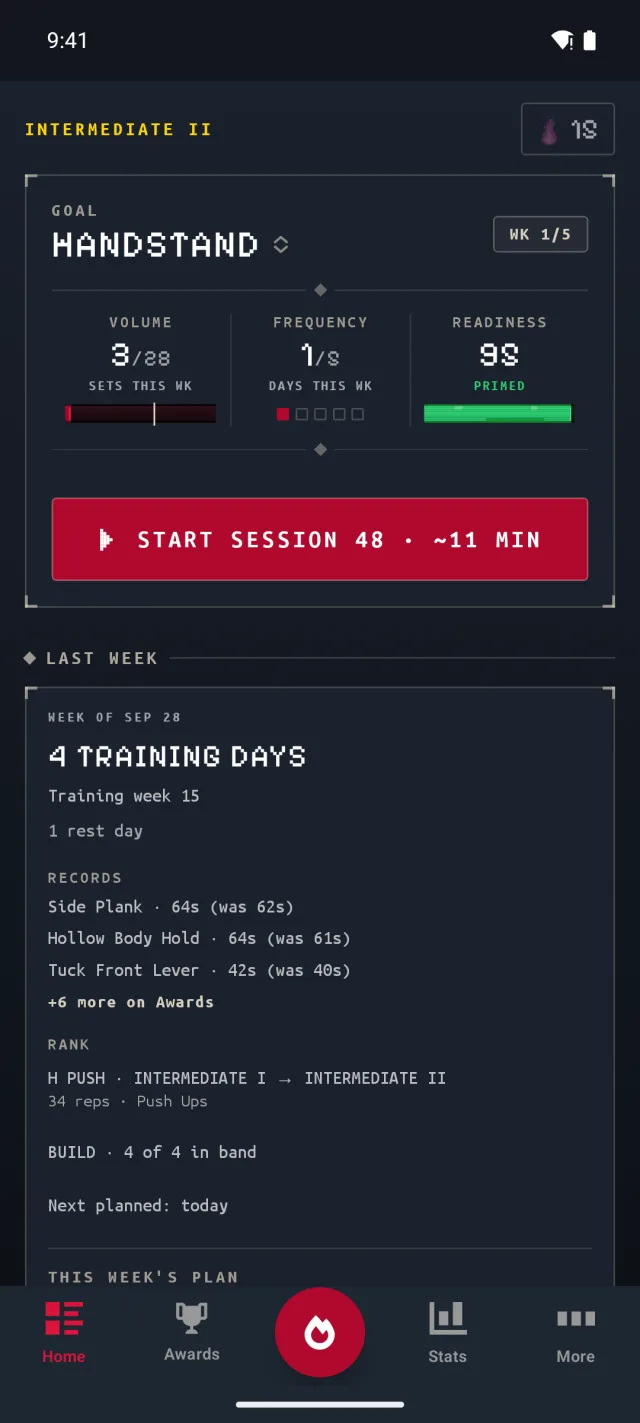
What it will not do: make you want to train. No app can, and one that promises to is selling the promise. What it can do is make the first session back small, make a short week count, and show you something true when you get there. Free to start, works offline, and no account needed.
Questions
Is it normal to lose motivation to work out?
Yes. Almost everyone who trains for more than a few months has weeks where they do not want to. It usually follows something specific: progress that stopped being visible, a plan too big for a hard week, or a streak that broke. Each of those has a fix that does not depend on feeling motivated.
Should I wait until I feel motivated to train again?
No. Motivation tends to follow action more than it precedes it. Plan one short session at a set time and place, do it, and record it. The first session back is the hardest one; the second is noticeably easier.
How long does it take to get back into a training habit?
Habits take longer than the popular 21 days. In a study that followed people building a new daily habit, it took a median of 66 days for the behaviour to feel automatic, with a range of 18 to 254 days. Missing a single day did not measurably set people back.
Did I lose all my progress after a few weeks off?
Very unlikely. Strength is generally well kept over short breaks of up to about four weeks, and it comes back faster than it was first built. Start at around two thirds of your last working sets and build back over two weeks.
Can an app fix a lack of motivation?
Not on its own, and an app that promises to is selling you something. What an app can do is keep your progress visible, make a short week count, and make the first session back easy to start. PlayThenics is built around those three things.
Sources
- Harkin B, Webb TL, Chang BPI, et al. Does monitoring goal progress promote goal attainment? A meta-analysis of the experimental evidence. Psychological Bulletin, 2016;142(2):198–229.
- Lally P, van Jaarsveld CHM, Potts HWW, Wardle J. How are habits formed: modelling habit formation in the real world. European Journal of Social Psychology, 2010;40(6):998–1009.
- Gollwitzer PM, Sheeran P. Implementation intentions and goal achievement: a meta-analysis of effects and processes. Advances in Experimental Social Psychology, 2006;38:69–119.
- Dai H, Milkman KL, Riis J. The fresh start effect: temporal landmarks motivate aspirational behavior. Management Science, 2014;60(10):2563–2582.
- Deci EL, Koestner R, Ryan RM. A meta-analytic review of experiments examining the effects of extrinsic rewards on intrinsic motivation. Psychological Bulletin, 1999;125(6):627–668.
- Mujika I, Padilla S. Detraining: loss of training-induced physiological and performance adaptations. Part I. Sports Medicine, 2000;30(2):79–87.
 Get PlayThenics on Google Play