If you searched for a calisthenics game, you probably want one of two things: training that feels like progressing through a game, or an actual game about calisthenics. PlayThenics is the first and not the second — and it draws that line on purpose. Here is exactly what is game-shaped in it, what was removed, and why.
What is game-shaped
| In a game | In PlayThenics |
|---|---|
| A skill tree | 54 progression steps from a wall push-up to the full planche, front lever, muscle-up and freestanding handstand push-up. Each step knows what comes before it; log a qualifying set and you own the step and the next one opens. |
| A level | A measured rank — Novice, Beginner I–III, Intermediate I–III, Advanced I–III, Elite — per movement pattern and overall, scored from your logged sets against published calisthenics standards. Every rank shows the set that earned it. |
| A HUD | The home screen is a heads-up display: sets this week against your band, training days against your target, and a readiness verdict — drawn in the app's pixel-art style. |
| Streaks | Yes, and a banked rest day keeps one alive, because a streak that punishes recovery teaches you to train hurt. |
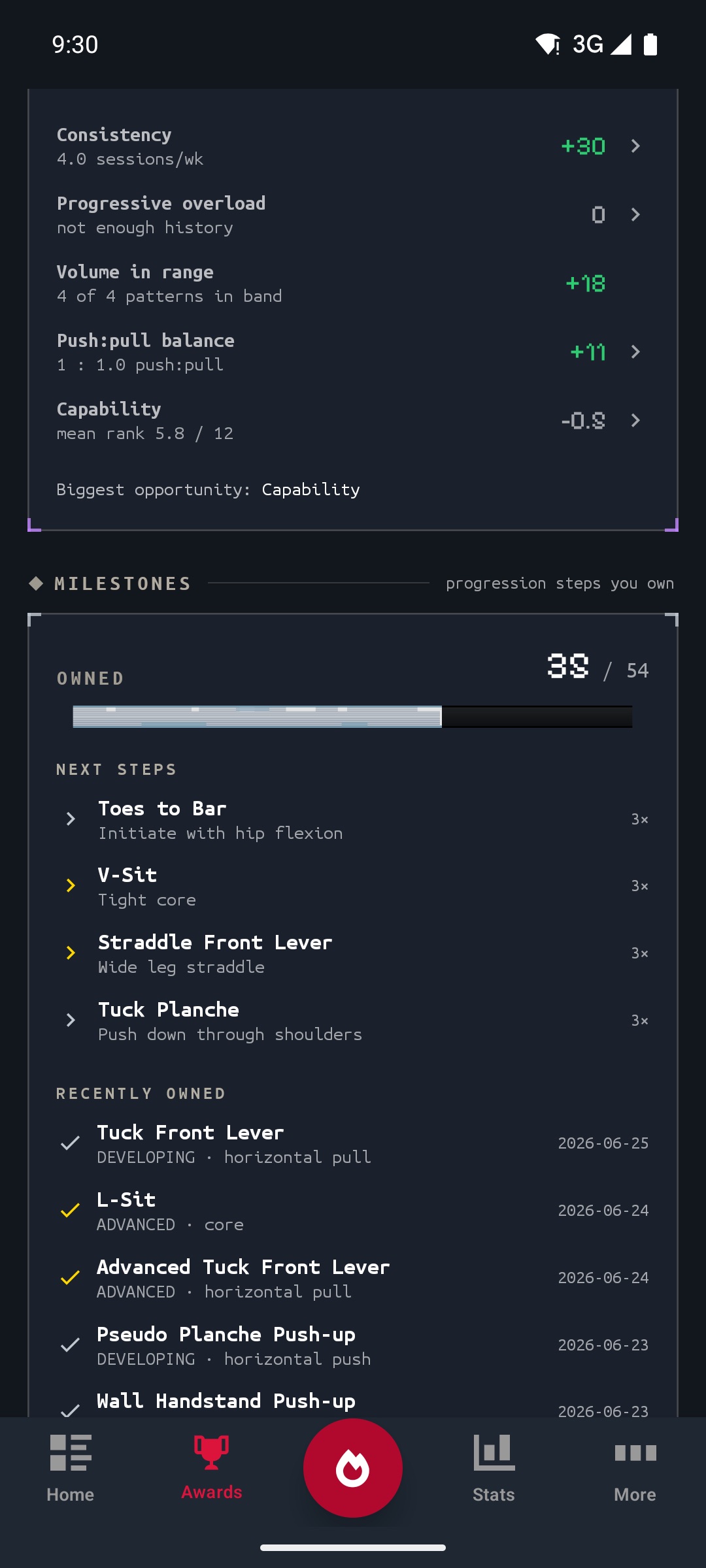
| Achievements | Milestones on the steps you own, auto-detected personal records, eleven journey markers, and an Athlete Index — all mapped to something you actually did. |
| Quests | A weekly plan: how many working sets each pattern needs, across how many days, and whether you are recovered enough to take them. Sunday reviews what landed. |
| Cosmetics | Pixel themes and flame skins, in Pro. |
What was deliberately removed
An earlier version of PlayThenics had experience points, a hundred levels and eighty badges. They were deleted. There is no XP, no level-up for opening the app, no points for logging a set, and no leaderboard — nothing in the app compares you with another athlete.
That is the whole design rule. Every game-shaped surface above is a view of the log, not a currency layered on top of it. The badges from the old version survive in a read-only archive for people who earned them; they are not the product.
Why XP fails for training
Experience points work in games because the game controls the whole world: the reward and the thing rewarded are the same thing. Training is not like that. The thing you want — a muscle-up, a sixty-second handstand, twenty strict pull-ups — exists outside the app, and no point total changes it. So an XP layer can only reward proxies: opening the app, logging something, keeping a streak. The first week, the proxy feels like progress. By the third, you have noticed that the number went up on a day you did nothing, and the number stops meaning anything. Worse, the research on motivation has a name for what happens next — when an external reward is attached to something you already wanted to do, the wanting tends to weaken once the reward is there. Self-determination theory calls it undermining intrinsic motivation; anyone who has quit a fitness app after the novelty wore off has felt it.
Measurement does not have this problem. A rank that says Intermediate II because you logged fourteen strict pull-ups is not a reward for using the app; it is a fact about you, and it would be the same fact in a notebook. You cannot farm it, so you cannot cheapen it, so it keeps meaning something.
The mechanics we kept, and the rule each one follows
| Mechanic | The rule that keeps it honest |
|---|---|
| Skill tree | A step is owned only by a logged set of at least three reps, or a hold of at least five seconds. One sloppy attempt does not unlock the planche. |
| Rank | Measured against published standards, takes the higher of rep evidence and position evidence, weights your weakest pattern at half of the overall figure. It never goes down for absence — after eight weeks without fresh evidence it shows as stale and asks for a retest. |
| Streak | A banked rest day keeps it alive. A streak that breaks on recovery teaches you to train hurt, so this one does not. |
| Milestones | Tied to steps on the tree, never to app usage. Fifty-four of them, one per step. |
| Records | Auto-detected, only ever against your own past. No leaderboard. |
| Athlete Index | Composed from things that predict progress — consistency, volume inside your productive range, push:pull balance — each shown as its own contribution. |
| Journey markers | Eleven of them, marking moments that actually happened: first session, first record, first deload taken on purpose. |
Every row is a view of the log. Delete the app's motivation layer entirely and the log is unchanged; that is the test each mechanic had to pass.
A session, as a game
- The quest. Home shows today's dose: the sets your weakest pattern is short of this week, on a day your readiness says you can take them. Three of six done, the rest open.
- The run. You log the sets. The rest timer survives backgrounding; the effort rating at the end feeds tomorrow's readiness.
- The drop. If a set was a personal best, the record is detected and marked. If it was the first time you held the advanced tuck for five seconds, the step lights up on the tree and the next one opens.
- The stats screen. Rank per pattern, with the set that proved each one. Momentum: the last four weeks against the four before. Load: the build-deload-rebound wave, against your own average.
- The end of the week. Sunday closes the loop with what actually landed against the plan, and Monday's plan is a choice you make, not a number handed down.
That is the loop. It is a good loop. It is not a slot machine, and it was not built to keep you in the app — if you read how gamified fitness apps go wrong, most of the failure modes are the ones this page says no to.
If you came from games
The mapping is honest and it holds up. The skill tree is a real dependency graph, not decoration: you cannot own the straddle front lever without the advanced tuck below it. The rank is measured, not accumulated, so grinding does not work — only getting stronger does. The daily dose is a quest with a real completion condition (the sets your weakest pattern is short of, on a day your recovery says you can take them). And the one mechanic games get wrong for training — the streak that breaks on a rest day — is fixed.
What you will not find is a reward loop designed to keep you in the app. Log the session, read the verdict, put the phone down.
You can turn all of it off
Each of the six motivation surfaces — streaks, rank, milestones, records, the Athlete Index, journey markers — has its own switch. With all of them off it is still a complete tracker with the skill tree, the plan and the stats.
Questions
Is PlayThenics a calisthenics game?
Not in the sense of something you play on the couch. It is a calisthenics tracker built with game structure: a skill tree of 54 progression steps, a rank ladder from Novice to Elite, a heads-up display for your week, streaks, milestones and records. What you do in it is train and log the sets; the structure turns that into visible progress.
Does it have XP, levels or points?
No. An earlier version had experience points, a hundred levels and eighty badges, and they were deleted. Nothing awards a number for opening the app and nothing can be farmed. Rank is measured from the sets you log against published standards; recomputing from your history always gives the same answer.
Is there a calisthenics skill tree?
Yes — that is the core of it. Every exercise sits on a ladder from a wall push-up to the full planche, front lever, muscle-up and freestanding handstand push-up. Log a qualifying set and you own that step and the next one opens. The tree has 54 steps and it is free.
Is there a leaderboard or a way to compete with friends?
No. There is no comparison to other athletes anywhere in the app. Every rank, record and streak is measured against your own past, and each of the six motivation surfaces can be switched off individually.
Is it free?
Logging, the full skill tree, overall rank, milestones, records and streaks are free, with no account and no signal needed. Pro adds the layer that reads the log back — the weekly plan, readiness, training load, the coach — plus pixel themes and flame skins.
 Get PlayThenics on Google Play